

Innovative Tech ETF Analysis: Space. Quantum. Cybersecurity. Small-Cap Tech. The Puck Has Moved.
Disruptive Tech ETF Relative Strength Rank & Trend Report | May 28, 2026 — Today's RS Rank & Trend data separates the real climbers from the expensive science projects.

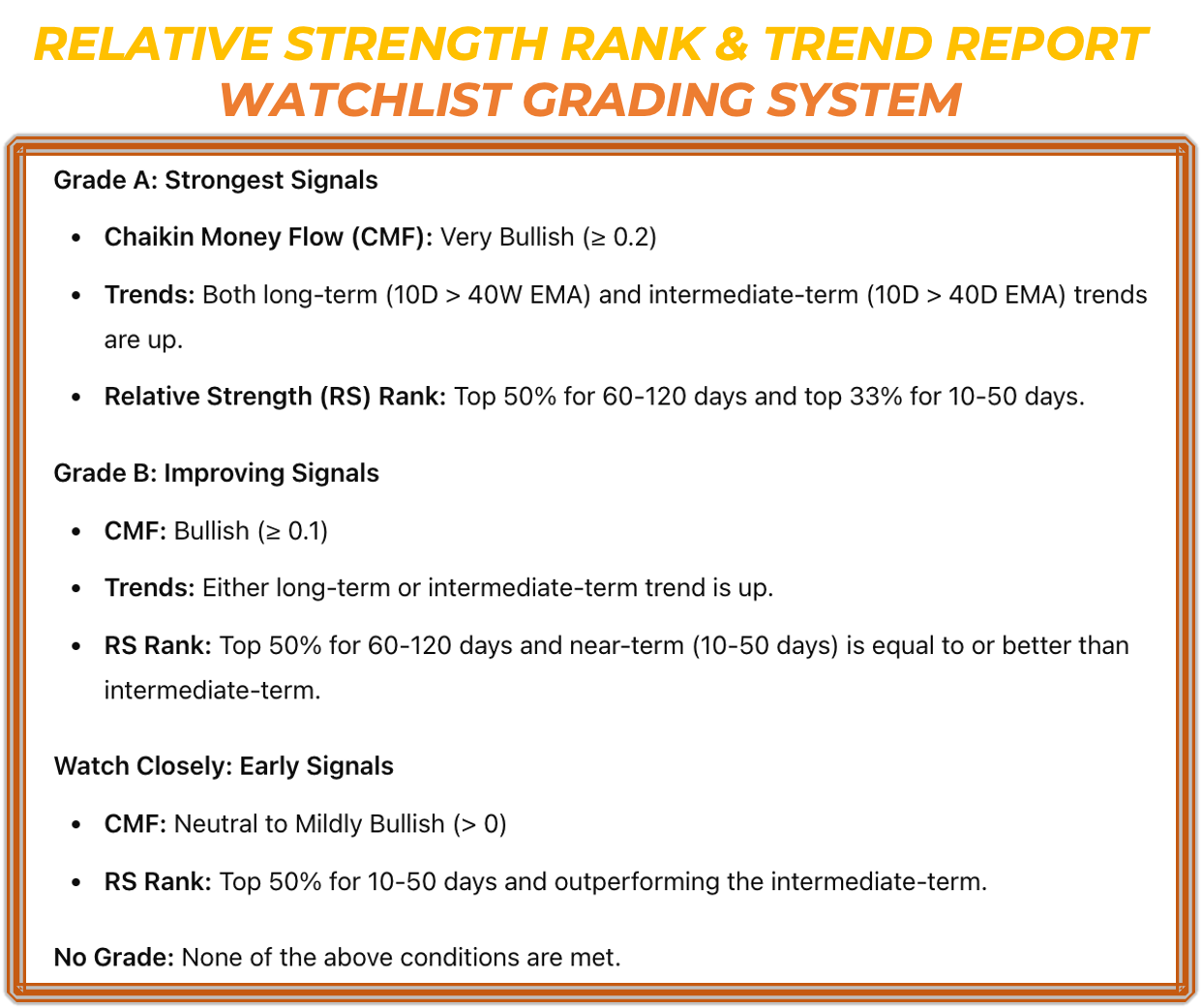
Our Relative Strength Rank & Trend Report is designed to give traders a cleaner read on where institutional money appears to be moving before the story becomes obvious in price headlines. Instead of looking only at which ETFs are already up, we compare longer-term relative strength against shorter-term rank changes, then cross-check those shifts against trend structure, Chaikin Money Flow, and RSI momentum.
That combination helps us separate real leadership from simple bounce attempts. An ETF with improving near-term relative strength, bullish daily and weekly EMA trends, and strong money flow is often telling us that buyers are already positioning — sometimes before the broader market narrative catches up. On the other side, an ETF with weak rank, deteriorating trend structure, or poor weekly money flow may still look fine on the surface while the underlying support is already fading
Innovative & Disruptive Tech ETF Relative Strength Rank & Trend Report
May 28, 2026 — The AI Climb Is Still Working, But the Best Setups Are No Longer Just “Big Tech”
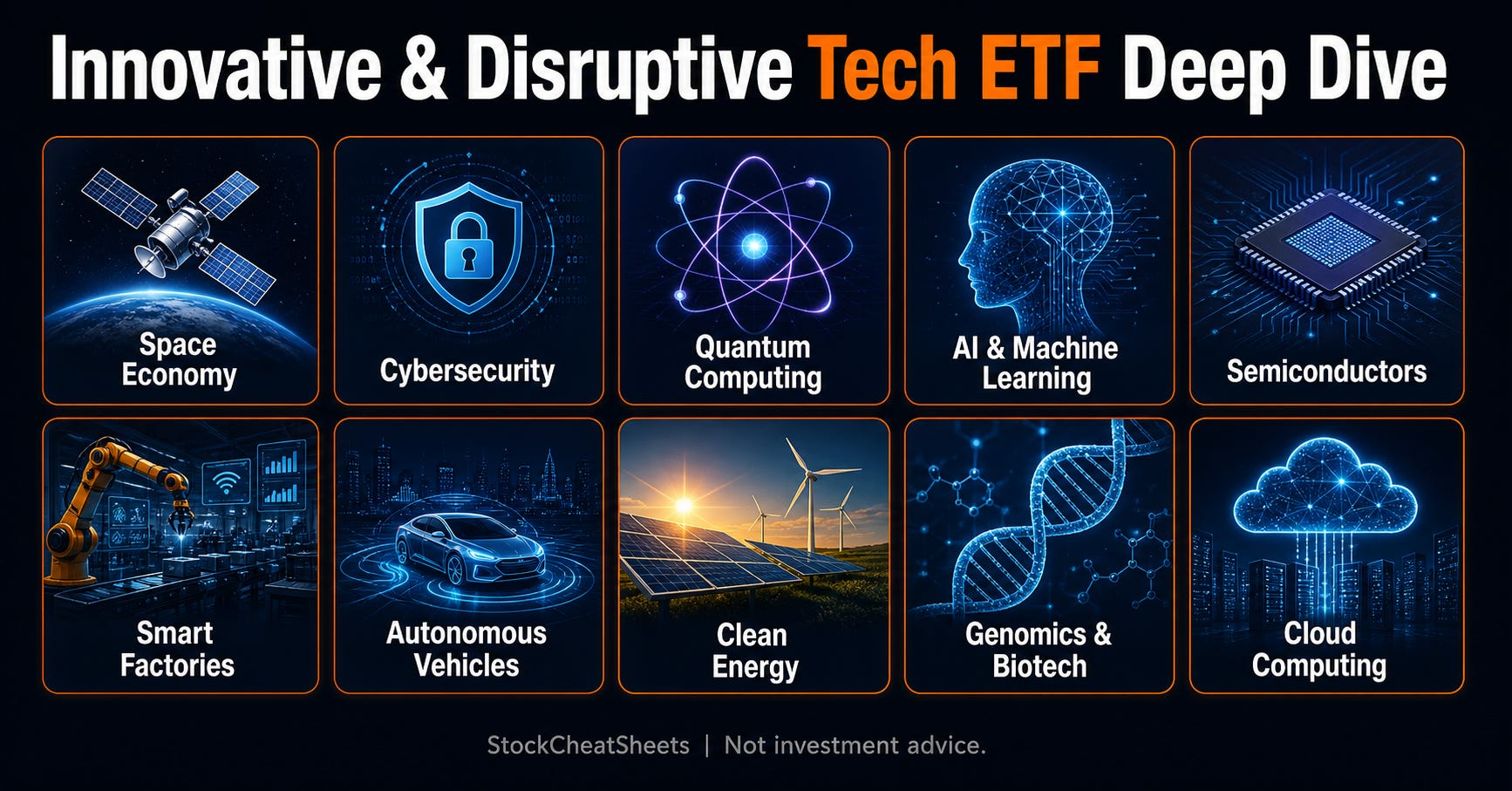
The innovation trade is not just alive — it’s rotating, and if you’re still mapping it through the QQQ lens alone, you’re reading last year’s map with this year’s terrain.
A day after our Global Asset Class ETF report confirmed the Invesco QQQ Trust (QQQ) — the Nasdaq-100 benchmark and core proxy for mega-cap growth and AI-related large-cap leadership — continued its leadership up the Wall of Worry, today’s disruptive-tech Relative Strength Rank & Trend data delivers a sharper, more granular message: the best setups are migrating into targeted themes — space, cybersecurity, quantum, semiconductors, AI infrastructure, small-cap tech, and smart factories — while the old “innovation story stock” complex continues to underperform. The winners are not distributed randomly. The data is pointing a very specific finger at which innovation sleeves are actually showing up with institutional footprints, and which are mostly hanging on the rope hoping nobody looks down.
The Macro Tape Today: Software, Semis, and Geopolitical Oxygen
Today’s session had three distinct catalysts converging, and all three matter for reading this report.
First, Snowflake (SNOW) reported Q1 FY2027 earnings after the bell Wednesday that were nothing short of a software-sector defibrillation. Adjusted EPS came in at $0.39, obliterating the consensus estimate of $0.32, on product revenue that grew 34% year-over-year to $1.33 billion. The company also announced a $6 billion investment commitment into Amazon’s cloud infrastructure — a deal that reads as much as a strategic alliance as a capital deployment event. Snowflake surged 35%, on pace for its best day ever, and pulled ServiceNow, Oracle, and Palantir along for the ride. Notably, Salesforce bucked the trend after its own disappointing print — a reminder that software is not a monolith right now. The read-through for the SPDR FactSet Innovative Technology ETF (XITK) and the SPDR S&P Software & Services ETF (XSW) in this report is direct: the software repair thesis is getting a genuine catalyst injection, but it is still not uniform. One Snowflake does not make a summer.
Second, the semiconductor tape remains on fire — and “on fire” may be an understatement. The VanEck Semiconductor ETF (SMH), which tracks major semiconductor companies and serves as one of the purest ETF proxies for AI hardware, chips, accelerators, and related infrastructure, is up approximately 42% year-to-date as of early May. Intel has surged roughly 70% year-to-date on a rapid succession of catalysts including improved earnings and a dramatic shift in market perception. Lam Research beat Q2 2026 consensus estimates with EPS of $1.27 against $1.17 expected, posting revenue growth of 22.1% year-over-year. The AI chip cycle is no longer a thesis — it is a capital expenditure reality baked into earnings across the supply chain.
Third, quantum computing got a direct government stimulus shot last week that is still reverberating through the tape. The U.S. Commerce Department announced $2 billion in grants — plus equity stakes — in nine quantum computing firms, with IBM receiving $1 billion, the largest single allocation. GlobalFoundries, D-Wave Quantum, Rigetti Computing, Infleqtion, and PsiQuantum are among the other recipients. Quantum stocks surged 40%+ in some cases in just the past week. For holders of the Defiance Quantum ETF (QTUM), which invests in companies tied to quantum computing, machine learning, cloud infrastructure, and advanced computing technologies, the government’s explicit endorsement of quantum as a national-priority technology isn’t just background noise — it is a direct tailwind to underlying constituents.
Finally, an under-the-radar geopolitical factor: reports this week of a potential U.S.-Iran truce, pending President Trump’s backing, lifted Nasdaq 100 futures and helped drive the software rebound session as macro risk-off pressure eased. Less geopolitical friction means fewer excuses to de-risk the innovation sleeve.
Click to enlarge data table(s). View on a tablet or computer for the best experience. Or keep scrolling for a detailed, mobile-friendly ticker-by-ticker analysis.
